

In October 2023, Google DeepMind* introduced technology that changed the way we look at content created with artificial intelligence. SynthID is a system for embedding invisible digital watermarks directly into AI-generated text, images, audio and video. As of May 2025, over 10 billion pieces of content already carry this invisible identifier.
* Google DeepMind is the AI research division of Google/Alphabet. In April 2023, Google merged its two AI teams – Google Brain and DeepMind – into a single entity called Google DeepMind.
Съдържание
What is SynthID
SynthID is a set of technologies for tagging and detecting content produced by AI models. Google DeepMind developed the system with one main goal – to make the provenance of digital content traceable. Unlike visible tags or metadata, the watermark is embedded directly into the content itself in a way that does not affect quality and remains imperceptible to the human eye.
Gemini uses SynthID for text, Imagen for images, Lyria for audio and Veo for video. Any content created using these models automatically gets watermarked.
Chronology of development
SynthID does not suddenly appear as a finished product. Google DeepMind is developing the technology in stages, expanding the reach to new content types.
In August 2023, the first imaging prototype integrated into the Imagen model is released. This is a response to the growing need for transparency in visual synthetic media. In May 2024, the technology is extended to text via Gemini and to video via Veo. October 2024 brings an important step – SynthID Text becomes open source and available through Hugging Face Transformers. In May 2025, Google introduces the unified SynthID Detector, which unifies detection for all media types in one place. November 2025 marks the global rollout along with the release of Gemini 3 Pro, allowing end users to verify content directly through the Gemini ecosystem.
The trajectory shows a clear pattern – from a closed internal tool to a developer-oriented protocol.
How the technology works
SynthID’s approach differs by content type.
For text, the system runs during the generation process itself. When a language model generates text, it selects each subsequent word based on probabilistic estimates. SynthID modifies these estimates in a controlled pseudo-random manner. The result is a statistical pattern in the text, invisible to the reader but recognizable by a specialized detector. Importantly, these modifications do not affect the meaning, quality, or creativity of the generated text.
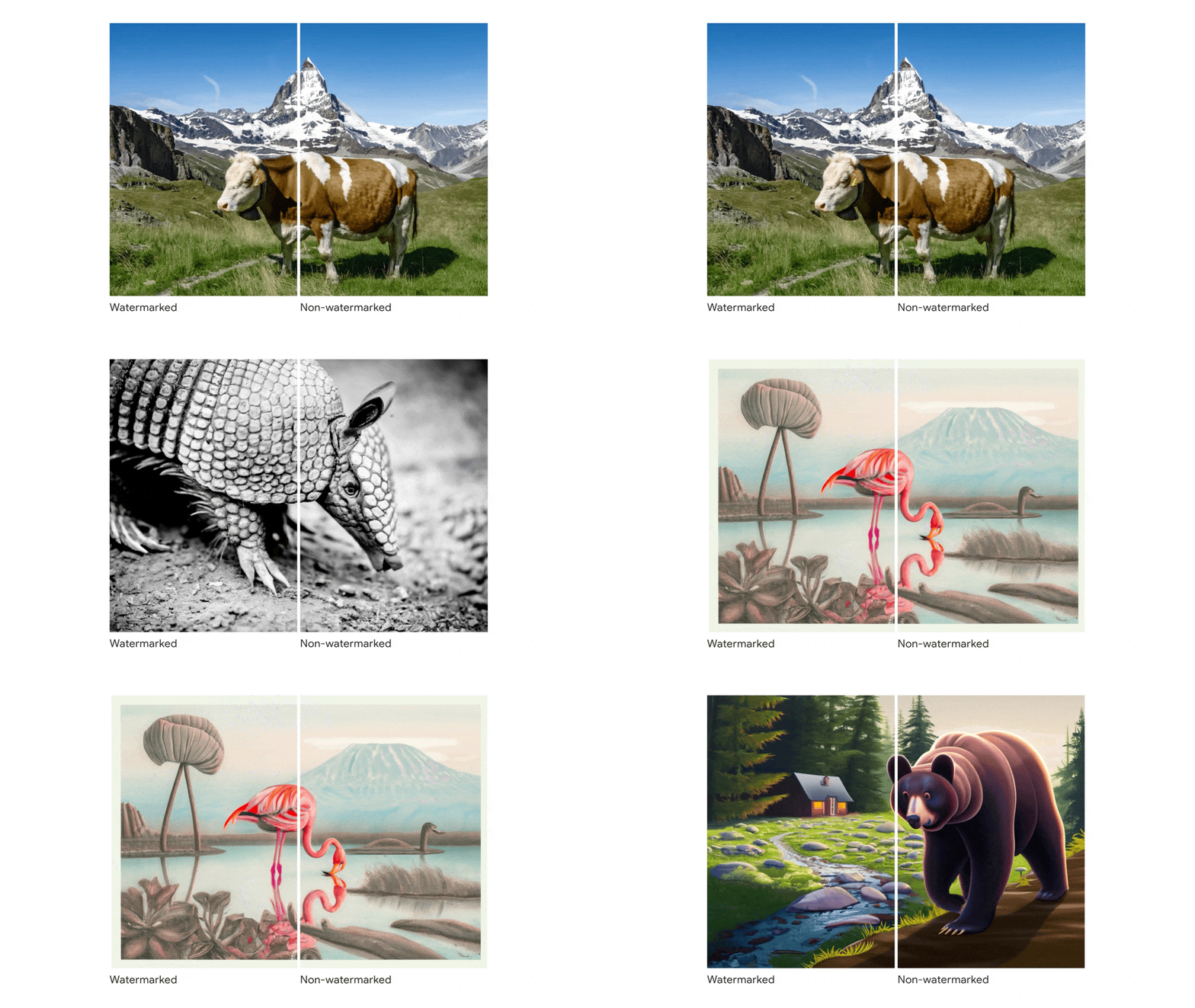
For images and video, SynthID uses two neural networks. The first modifies the color values of individual pixels so minimally that the change remains imperceptible to the human eye. The second network can detect these changes even after typical manipulations such as cropping, compression, filtering, or taking a screenshot. In video, each frame receives an individual watermark.
For audio, the system converts the sound wave into a spectrogram – a visual representation of the frequency spectrum. The watermark is embedded in the spectrogram and the audio is then reconstructed. The sign remains inaudible but resistant to standard processing such as MP3 compression.
Technical architecture
SynthID differs fundamentally from traditional watermarking. Instead of adding separable metadata, the technology integrates identification markers at the generation level. The approach uses principles of steganography, the practice of hiding information in other data. Unlike the C2PA standard, which works with metadata, SynthID operates directly at the model and pixel level.
Imaging Architecture
The system uses two deep learning models trained jointly on a diverse set of images. The first model, called the “embedder”, modifies pixel values during the generation process itself. The changes are mathematically significant to a computer but invisible to the human eye. The second model, the “detector”, is trained to recognize these specific patterns. The combined model is optimized for multiple purposes simultaneously – correctly identifying tagged content and improving imperceptibility by visually aligning the watermark with the original content.
Because the watermark is distributed throughout the image at the pixel level, it is resistant to cropping, rotation, compression, and filters.
Tournament Sampling for Text
Text is the hardest content type to mark up because you can’t “hide” pixels in a plain text file. SynthID Text uses a statistical method called Tournament Sampling.
Large language models generate text by predicting the next token (word or symbol) in a sequence based on probability. SynthID interferes with this prediction layer. The system uses a pseudorandom model based on a secret key to create bias in the choice of tokens. To a human reader, the text looks perfectly natural, but the statistical model remains detectable.
A single page of text can contain hundreds of modified probabilistic estimates. The technique works even for three sentences, but as the length of the text increases, the robustness and detection accuracy increase.
Spectrogram approach for audio
For audio, SynthID doesn’t just add a high-frequency signal that one can’t hear and that would be lost in MP3 compression. Instead, the watermark is embedded in the frequency domain of the audio track, woven into the sound wave data itself. This ensures the experience of lossy compression (MP3, AAC), added noise and speed changes.
Practical application and accessibility
SynthID Text is publicly available via an open source version integrated into the Hugging Face Transformers library (version 4.46.0 and later). Developers can use it with their own models without additional training – a configuration passed to the method .generate() is sufficient.
SynthID Text:
- Hugging Face Transformers ( integrated implementation):
- GitHub ( reference implementation):
- Official documentation from Google:
The configuration requires two main parameters. The keys parameter contains a list of unique random numbers that determine how the watermark is embedded. These keys must be kept confidential because revealing them would allow imitation of the watermark. The ngram_len parameter balances between robustness and discoverability. Higher values make the watermark easier to detect but more vulnerable to changes. The recommended value is 5.
In May 2025, Google launched SynthID Detector, a verification portal where journalists, media professionals and researchers can upload content and check for watermarks. The portal shows not only whether content is watermarked, but also which specific pieces carry the watermark.
SynthID Detector is not yet publicly available ( As of January 2026). There are two ways to check:
- Via Gemini ( available to all):
- Go to https://gemini.google.com
- Upload image or video
- Ask if it’s built with Google AI
- Or email
@synthidto start verification
- SynthID Detector Portal ( restricted access):
- Still in testing phase with journalists and media professionals
- There is a waitlist form: https://docs.google.com/forms/d/1KAkSpRixcGi7pKaPyw5FyahaQqpawmNq65gHgBWgFjg/viewform
Why SynthID is used
The main motivation behind SynthID is to fight misinformation and misattribution. With the increasing quality of AI-generated content, the ability to distinguish between human and machine-generated material is becoming increasingly difficult.
A 2023 study showed that participants could distinguish AI text from human text with only 50-52 percent accuracy – a virtually random result. The number of deepfake videos online grew by 550 percent between 2019 and 2023. These data illustrate why technologies like SynthID are becoming a necessity.
Google does not present SynthID as a tool to stop motivated abuse. The company acknowledges that the system can be circumvented by complete rewriting or translation into another language. Rather, the goal is to make mass abuse more difficult and create a basis for building trust in the digital space.
Limitations of the technology
SynthID is not a solution for all situations. In text, the watermark is less effective for factual responses where word choice is severely limited. If the AI model is answering questions such as the capital of a particular country, the opportunities for modifying probabilities are minimal without affecting accuracy.
Translation into another language significantly reduces the detectability. The same applies to a complete reworking of the text. Light editing and paraphrasing usually does not remove the watermark, but intensive processing can make it undetectable.
In images and video, aggressive filters, extreme changes in contrast or re-encoding with different parameters can compromise the watermark. For audio, changing the tonality or tempo affects the spectrogram and reduces the detection accuracy.
Another limitation is the scope.
SynthID маркира само съдържание от моделите на Google.
Text from ChatGPT, Claude, Mistral or DeepSeek does not contain this watermark. This means that the detector only works for some of the AI-generated content on the web.
What are other AI companies doing?
OpenAI (ChatGPT):
- There is ready technology for text watermarks with 99.9% accuracy
- Refused to implement it due to:
- 30% of users say they will use ChatGPT less
- Easily circumvented by translation or reformulation
- Potential discrimination against non-native English speakers
- Instead use C2PA metadata for images (DALL-E 3, Sora)
- Explore metadata embedding as an alternative
Anthropic (Claude):
- Signed a voluntary commitment to the White House in 2023 to develop watermarking
- Watermarking is “in the roadmap” but remains in R&D phase
- No publicly implemented watermark at the moment
Meta:
- Also signatories to the 2023 commitment
- Use proprietary systems other than SynthID
- No public information on text watermarks
Partners with SynthID:
- NVIDIA uses SynthID for Cosmos model videos
- GetReal Security integrates SynthID detection
- The open source version allows anyone to deploy it
As of January 2026, there is no industry standard. Google is the only one actively marking up text. The others have either given up (OpenAI) or are still exploring (Anthropic, Meta).
Scientific publication and scale
In October 2024, Google published a detailed description of the method in the scientific journal Nature. The paper documents the technical requirements, threat models, and practical challenges of implementing such a system at Internet scale.
The scale of deployment is impressive. SynthID has been used to tag over 10 billion images and video frames across Google services. For context – AI has generated more images so far than humanity has created in hundreds of years. The number of news photos taken each year has remained relatively stable, while the volume of content generated has grown exponentially.
Regulatory framework in the EU
The European Union has introduced AI content tagging obligations through the AI Act. Article 50 of the regulation requires providers of generative AI systems to ensure that their outputs are marked in a machine-readable format and detectable as artificially generated or manipulated.
In December 2025, the European Commission published the first draft of a Code of Practice on the transparency of AI-generated content. The document does not mandate a specific technology such as SynthID, but recommends a multi-layered approach including metadata, invisible watermarks, fingerprinting and logging systems.
The Code provides that the AI terms of service must expressly prohibit the removal or modification of watermarks. For open-weight models, it is recommended to embed structural markup techniques directly into the weights during training.
The full implementation of Article 50 shall enter into force in August 2026. Fines for non-compliance can reach €15 million or 3 percent of global annual turnover.
Impact on SEO and GEO
Google officially states that it doesn’t penalize content just because it was created with AI. The company’s position is that what matters is whether the content is useful, accurate and user-centric, not how it was produced.
In practice, however, the situation is more complicated. SynthID gives Google the technical ability to identify machine-generated text from its own models. Whether and how this information affects rankings is a matter of speculation. Google does not confirm a direct link between watermarks and ranking, but the mere existence of such technology changes the dynamic.
Studies show a correlation between sites relying heavily on AI content and a drop in rankings after algorithm updates. This doesn’t mean an automatic penalty for AI text, but it does highlight the importance of human intervention – adding expertise, fact-checking, a unique perspective.
For GEO (Generative Engine Optimization) – optimization for AI assistants like ChatGPT Search and Gemini – the question is even newer. These systems often prefer content with proven authenticity and authority. Tagged AI content may receive different treatment than untagged content, though the specific mechanisms are not public.
The practical recommendation remains the same: AI can serve as an assistant in content creation, but not as a substitute for human expertise. Editing, adding original insights and verifying information remain critical factors.
The ecosystem and partnerships
Google is not working in isolation on SynthID. The company is creating partnerships to expand the ecosystem. NVIDIA is using SynthID to tag videos from their Cosmos model. GetReal Security, a content verification platform, integrates SynthID watermark detection into its services.
The open source version of SynthID Text allows any developer to embed the technology in their own models. This is a step towards creating an industry standard, although other major players such as OpenAI and Meta continue to use different approaches.
OpenAI even canceled its text watermarking plans after an internal survey showed that 30 percent of users would use the service less when entering markup. This illustrates the tension between technical feasibility and market acceptance.
What it means for content creators
If you use the Gemini API to generate text, each output now carries a SynthID watermark. This is automatic and requires no action on your part. Other popular models such as GPT-4, Claude or Mistral do not embed such characters.
For those who want to remove the watermark, processing through a synonymizer or spinner can technically override the statistical model. However, this does not guarantee the quality of the final text and raises ethical issues.
A better approach is to adopt AI as a tool in the creation process rather than as a source of a finished product. Editing, factchecking and adding in-house expertise not only improves quality, but also reduces dependency on specific technology solutions.
Conclusion
SynthID represents an ambitious attempt to solve a real problem – the lack of transparency in AI-generated content. The technology isn’t perfect and doesn’t pretend to be. Motivated abuses can circumvent it. But for mass-produced content, it raises the bar.
With regulations such as the EU AI Act and growing public attention to the authenticity of information, technologies such as SynthID are likely to become more prevalent. For content creators, the question is not whether to use AI, but how to do so responsibly – with their own input that makes the final product more valuable than the sum of its automated parts.
https://deepmind.google/models/synthid
https://www.nature.com/articles/s41586-024-08025-4

